
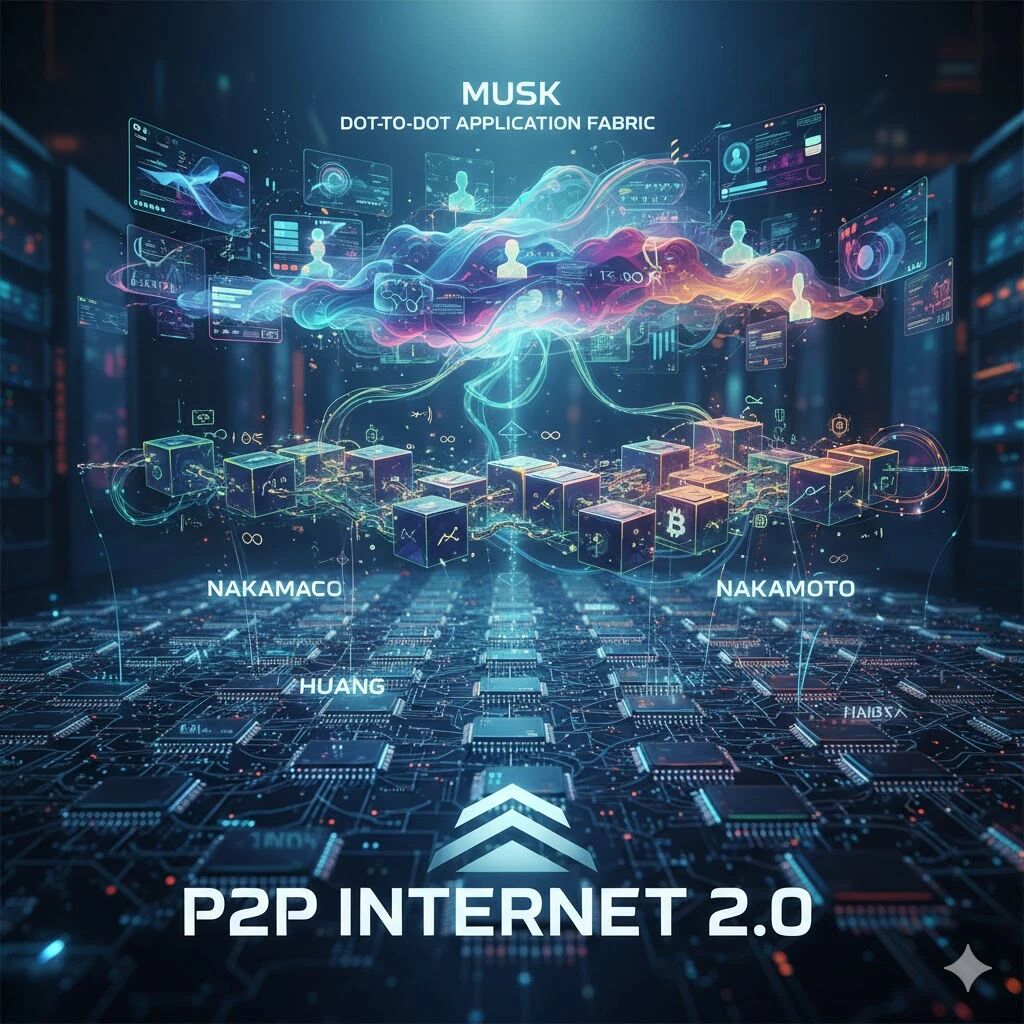
When we talk about the future of the Internet, people often focus on AI, Web3, or large models. But beneath these trends lies a deeper, more systematic, and more structural new force reshaping the entire technology stack— The full return and evolution of the “Peer-to-Peer (P2P)” philosophy.
Here, P2P is no longer just the old BitTorrent download protocol, but a new philosophy of computation: Computation moves from centralized organizations to peer-to-peer autonomous collaboration.
This evolution can be clearly seen as a three-stage chain from compute architecture → software organization → application ecosystem. More importantly, each stage is driven by one of the most important technological figures of their era:
Together, they form a complete closed loop for the future Internet:
Peer-to-peer compute layer → peer-to-peer organizational layer → peer-to-peer application layer.
We call this: P2P Internet 2.0.
GPU: Giving compute itself peer-to-peer properties
The revolutionary meaning of GPUs is not only their speed, but that they reconstruct the structure of compute. Traditional CPUs are centralized: strong single core, serial execution, central instruction scheduling.
GPUs transform compute from a “central brain” into “massively autonomous units”:
In other words: The GPU is the physical carrier of peer-to-peer compute structure. It delivers a Compute Fabric, providing a parallel, open, P2P-native substrate for distributed systems.
Bitcoin: Delivering a stable evolutionary mechanism without a center
After achieving peer-to-peer compute, the next key question becomes:
“How can mutually untrusted P2P nodes form a single time order and shared conclusions?”
Satoshi’s answer is a dual structure consisting of two open systems:
① Ordinal Logic System
Transforming “double-spend conflict” into a comparable “block height”
A globally shared, naturally increasing ordinal chain gives the entire network a unified, public, tamper-proof “timeline”.
This is equivalent to giving a P2P network a global clock.
② Non-cooperative Game System
Using PoW (Proof of Work)
Allowing mutually self-interested, non-cooperative nodes to still converge toward the same optimal strategy: extend the longest chain.
These two systems mirror each other and form the first structure in Internet history that is: Centerless, self-organizing, and self-verifying — a peer-to-peer software organization layer.
This is what Satoshi delivered: the Consensus / Organization Fabric.
XAI: Delivering a non-clonable peer-to-peer application ecosystem
Once the compute and organizational layers have become P2P, the application ecosystem begins to break away from the traditional:“Centralized app store → download apps → passive use” model.
Musk is driving a completely new application paradigm: From Apps → Auto-generated Applications.
Future applications will no longer be static packages, but: User behavior × global model → instantly generated interfaces, tools, and workflows
This comes with two revolutionary properties:
1) Non-clonable
Because applications are generated in real time, the application state for each user is unique.
2) Peer-to-peer distribution
Every user node becomes part of the application ecosystem, not merely a “consumer.” This forms the Application Fabric — a continuously evolving, non-replicable, non-centralized dynamic universe of applications.
Combining all three layers, we obtain a self-consistent logical loop:
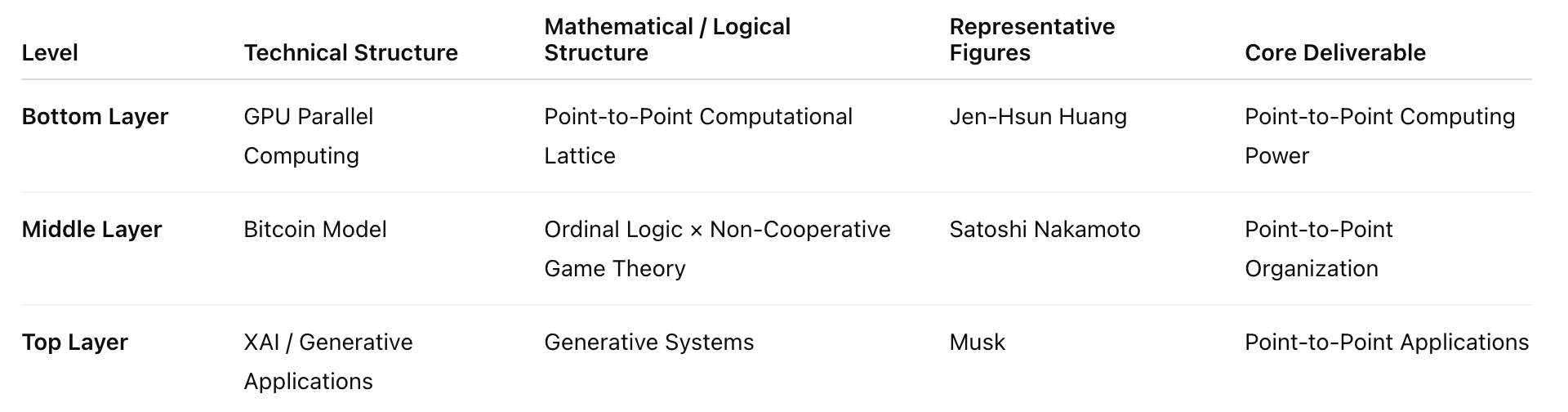
Peer-to-peer compute → peer-to-peer organization → peer-to-peer applications
This is not DeFi, nor Web3, nor simply an AI Internet. It is a transformation across hardware, software, and ecosystems— A complete P2P-ization of the underlying structure of computational civilization.
And this is the structural trend truly worth paying attention to over the next decade.
